


PDF Download How We Decide, by Jonah Lehrer
As one of the home window to open up the brand-new globe, this How We Decide, By Jonah Lehrer supplies its remarkable writing from the author. Released in one of the prominent authors, this publication How We Decide, By Jonah Lehrer becomes one of one of the most desired publications just recently. In fact, guide will not matter if that How We Decide, By Jonah Lehrer is a best seller or otherwise. Every publication will certainly consistently give best resources to obtain the visitor all finest.
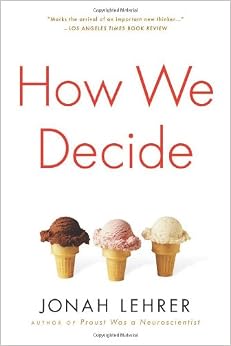
How We Decide, by Jonah Lehrer

PDF Download How We Decide, by Jonah Lehrer
How We Decide, By Jonah Lehrer. Accompany us to be participant right here. This is the site that will give you reduce of searching book How We Decide, By Jonah Lehrer to read. This is not as the other website; the books will be in the types of soft documents. What benefits of you to be member of this website? Get hundred compilations of book connect to download as well as get constantly updated book everyday. As one of guides we will certainly offer to you now is the How We Decide, By Jonah Lehrer that includes a quite satisfied idea.
And why do not try this publication to check out? How We Decide, By Jonah Lehrer is one of the most referred reading material for any kind of levels. When you really intend to seek for the new motivating book to check out and also you do not have any kind of concepts in all, this complying with book can be taken. This is not complicated publication, no challenging words to review, as well as any complicated style and subjects to understand. The book is very appreciated to be among one of the most inspiring coming publications this recently.
Are you still puzzled why should be this publication? After having excellent work, you might not need something that is very hard. This is what we claim as the affordable publication to read. It will not just offer enjoyment for you. It will offer life lesson behind the entertaining attributes. From this instance, it is definitely that this book is appropriate for you and also for all individuals that require basic and fun publication to check out.
So, all individuals that review How We Decide, By Jonah Lehrer will feel like doing the important things by themselves. It relies on how the visitors stare and also consider this book. Yet, commonly, it actually includes the amazing thoughts of guide analysis. It will additionally give you the remarkable systems of creative thinking. Obviously, it will certainly serve you better concept of excellences. It is why we always offer you the most effective publication that can make your life better. Currently, really feel the life to obtain the incredible methods of book success.
Amazon.com Review
Product Description The first book to use the unexpected discoveries of neuroscience to help us make the best decisions.Since Plato, philosophers have described the decision-making process as either rational or emotional: we carefully deliberate, or we blink and go with our gut. But as scientists break open the mind's black box with the latest tools of neuroscience, they re discovering that this is not how the mind works. Our best decisions are a finely tuned blend of both feeling and reason and the precise mix depends on the situation. When buying a house, for example, it's best to let our unconscious mull over the many variables. But when we're picking a stock, intuition often leads us astray. The trick is to determine when to use the different parts of the brain, and to do this, we need to think harder (and smarter) about how we think.Jonah Lehrer arms us with the tools we need, drawing on cutting-edge research as well as the real-world experiences of a wide range of deciders from airplane pilots and hedge fund investors to serial killers and poker players. Lehrer shows how people are taking advantage of the new science to make better television shows, win more football games, and improve military intelligence. His goal is to answer two questions that are of interest to just about anyone, from CEOs to firefighters: How does the human mind make decisions? And how can we make those decisions better? A Q&A with Jonah Lehrer, Author of How We Decide Q: Why did you want to write a book about decision-making? A: It all began with Cheerios. I'm an incredibly indecisive person. There I was, aimlessly wandering the cereal aisle of the supermarket, trying to choose between the apple-cinnamon and honey-nut varieties. It was an embarrassing waste of time and yet it happened to me all the time. Eventually, I decided that enough was enough: I needed to understand what was happening inside my brain as I contemplated my breakfast options. I soon realized, of course, that this new science of decision making had implications far grander than Cheerios. Q: What are some of those implications? A: Life is ultimately just a series of decisions, from the mundane (what should I eat for breakfast?) to the profound (what should I do with my life?). Until recently, though, we had no idea how our brain actually made these decisions. As a result, we relied on untested assumptions, such as the assumption that people were rational creatures. (This assumption goes all the way back to Plato and the ancient Greeks.) But now, for the first time in human history, we can look inside our mind and see how we actually think. It turns out that we weren't designed to be rational or logical or even particularly deliberate. Instead, our mind holds a messy network of different areas, many of which are involved with the production of emotion. Whenever we make a decision, the brain is awash in feeling, driven by its inexplicable passions. Even when we try to be reasonable and restrained, these emotional impulses secretly influence our judgment. Of course, by understanding how the human mind makes decisions--and by learning about the decision-making mistakes that we're all vulnerable to--we can learn to make better decisions. Q: Can neuroscience really teach us how to make better decisions? A: My answer is a qualified yes. Despite the claims of many self-help books, there is no secret recipe for decision-making, no single strategy that can work in every situation. The real world is just too complex. The thought process that excels in the supermarket won't pass muster in the Oval Office. Therefore natural selection endowed us with a brain that is enthusiastically pluralist. Sometimes we need to reason through our options and carefully analyze the possibilities. And sometimes we need to listen to our emotions and gut instinct. The secret, of course, is knowing when to use different styles of thought--when to trust feelings and when to exercise reason. In my book, I devoted a chapter to looking at the world through the prism of the game of poker and found that, in poker as in life, two broad categories of decisions exist: math problems and mysteries. The first step to making the right decision, then, is accurately diagnosing the problem and figuring out which brain system to rely on. Should we trust our intuition or calculate the probabilities? We always need to be thinking about how we think. Q: Are you a good poker player? A: When I was in Vegas, hanging out with some of best poker players in the world, I convinced myself that I'd absorbed the tricks of the trade, that I could use their advice to win some money. So I went to a low-stakes table at the Rio, put $300 on the line, and waited for the chips to accumulate. Instead, I lost all my money in less than an hour. It was an expensive but valuable lesson: there's a big difference between understanding how experts think and being able to think like an expert. Q: Why write this book now? A: Neuroscience can seem abstract, a science preoccupied with questions about the cellular details of perception and the memory of fruit flies. In recent years, however, the field has been invaded by some practical thinkers. These scientists want to use the nifty experimental tools of modern neuroscience to explore some of the mysteries of everyday life. How should we choose a cereal? What areas of the brain are triggered in the shopping mall? Why do smart people accumulate credit card debt and take out subprime mortgages? How can you use the brain to explain financial bubbles? For the first time, these incredibly relevant questions have rigorously scientific answers. It all goes back to that classical Greek aphorism: Know thyself. I'd argue that the discoveries of modern neuroscience allow us to know ourselves (and our decisions!) in an entirely new way. Q: How We Decide draws from the latest research in neuroscience yet also analyzes some crucial moments in the lives of a variety of "deciders," from the football star Tom Brady to a soap opera director. Why did you take this approach? A: Herbert Simon, the Nobel Prize-winning psychologist, famously compared our mind to a pair of scissors. One blade, he said, represented the brain. The other blade was the specific environment in which our brain was operating. If you want to understand the function of scissors, Simon said, then you have to look at both blades simultaneously. What I wanted to do in How We Decide was venture out of the lab and into the real world so that I could see the scissors at work. I discuss some ingenious experiments in this book, but let's face it: the science lab is a startlingly artificial place. And so, wherever possible, I tried to explore these scientific theories in the context of everyday life. Instead of just writing about hyperbolic discounting and the feebleness of the prefrontal cortex, I spent time with a debt counselor in the Bronx. When I became interested in the anatomy of insight (where do our good ideas come from?) I interviewed a pilot whose epiphany in the cockpit saved hundreds of lives. That's when you really begin to appreciate the power of this new science--when you can use its ideas to explain all sorts of important phenomena, such as the risky behavior of teenagers, the amorality of psychopaths, and the tendency of some athletes to choke under pressure. Q: What do you do in the cereal aisle now? A: I was about halfway through writing the book when I got some great advice from a scientist. I was telling him about my Cheerios dilemma when he abruptly interrupted me: "The secret to happiness," he said,"is not wasting time on irrelevant decisions." Of course, this sage advice didn't help me figure out what kind of cereal I actually wanted to eat for breakfast. So I did the only logical thing: I bought my three favorite Cheerios varieties and combined them all in my cereal bowl. Problem solved. (Photo © Nina Subin, 2008)
Read more
From Publishers Weekly
“As Lehrer describes in fluid prose, the brain’s reasoning centers are easily fooled, often making judgments based on nonrational factors like presentation (a sales pitch or packaging)...Lehrer is a delight to read, and this is a fascinating book (some of which appeared recently, in a slightly different form, in the New Yorker) that will help everyone better understand themselves and their decision making.†—Publisher's Weekly, starred review
Read more
See all Editorial Reviews
Product details
Hardcover: 302 pages
Publisher: Houghton Mifflin Co; 1 edition (February 9, 2009)
Language: English
ISBN-10: 0618620117
ISBN-13: 978-0618620111
Product Dimensions:
5.5 x 1 x 8.5 inches
Shipping Weight: 1 pounds (View shipping rates and policies)
Average Customer Review:
4.1 out of 5 stars
316 customer reviews
Amazon Best Sellers Rank:
#45,457 in Books (See Top 100 in Books)
Are you trying to decide whether to read this book? I would tell your rational brain that this book is more about good (and bad) decision making. I would tell your emotional brain that you may enjoy the many "real life" examples set forth in this book. If you still can't decide, maybe you should just flip a coin.The real life examples from sports, politics, commercial aviation, gambling, etc may seem a little dated, but they are still applicable.
While the author's reputation may have suffered and his books largely consigned to the rubbish bin, I'd had this on my shelf for a long time and finally decided to read it. It is well written, entertaining and enlightening. It's too bad that the author who wrote it made such bad decisions himself.
I thoroughly enjoyed this book. I read it on one (long) airplane flight, and was captivated by the material.---The Good Points---* Lehrer does an excellent job of summarizing what is known about the brain's process for making decisions. He takes the reader through many examples of what happens on a chemical/electrical/biological basis inside the brain when it is going through a specific thought process. I found this material fascinating.* There is also a good amount of material presented on how the brain makes decisions, and how this decision process can be enhanced or corrupted based on outside factors-how busy the brain is, the external environment, preconceived notions. In one experiment that I found fascinating, people were asked to remember either a 2 or 7 digit number. Those tasked with the two digit number were far less likely to be tempted by an offer of chocolate cake. Explained very much about my diet...* Lehrer also takes the reader through numerous real world examples of decisions made in real time, and under stressful circumstances. Airline pilots seem to be a favorite area or research, and some of the stories and analysis were fascinating.* The book is easy to read, light on technical and medical jargon, and presented more as mass-market non-fiction than any sort of research or scholarly work. I found it to have just the right level of technical detail, but I am pretty much a novice as brain surgery.---The Not-So-Good Points---* There is nothing new in the book, at least that I could discern. Mostly it is a rehash of existing work, albeit with some explanatory verbiage wrapped around it. Anyone who has read other books in this general area would probably be disappointed.* It ended too soon. For each of the chapters, I always wanted to read more material about the subject and explanations of the results observed.---Summary---An excellent book if you haven't read much material in this area.
How We Decide is another book in a increasingly-popular genre that uses anecdotal examples to advance neurological, psychological or economic patterns. More than a few authors have attempted to exploit the genre since Freakonomics exploded a few years ago. This book is another in long line of this genre, which cultural critic Adam Hanft has referred to as "pattern porn." I had high expectations for the book and its author, Jonah Lehrer, from reading his Frontal Cortex blog.Throughout the book, Lehrer uses many examples that are already familiar to anyone who has read other books in this now-familiar genre. Examples include the propensity of wine experts to choose cheaper wines in blind tests; how experiment subjects based purchasing decisions on seemingly random items such as their social security numbers; and numerous others. He also reviews much familiar territory in behavorial economics/social psychology/neuroscience such as loss aversion, the anchoring effect, and the placebo effect.One of the early messages of the book is that we should embrace emotion in our decision-making. This is contrary to the popular notion that emotions get in the way of "rational thinking." Emotions are actually critical to decision making. We are paralyzed without it. That is why Tom Brady identifies the right receiver in milliseconds; why a soap opera director can identify the "it" factor in actor rehearsals, and why a radar technician can distinguish an enemy missile from a friendly jet just by a literal blip on the radar.The use of emotions as decision enhancement is valid technically from a physiological perspective. Lehrer deftly explains in an understandable manner the role of dopamine receptors as emotional decision makers. But, he tries very hard to maintain that ignorance is bliss. Lehrer contends Plato and his Enlightenment successors such as Decartes, Rousseau, and Jefferson (on this side of the pond) had it all wrong to promote reason over emotion. Reason is a blunt instrument suited only for the simplest of tasks. It is like a calculator - useful, but limited. And, there is such a thing as too much analysis.EXCEPT - "Novel problems" also require reason, as Lehrer states toward the end of the book. He concedes that "intelligent intuition (emotion)" is the result of deliberate practice. So, emotions and gut feelings work well as long as you practice at it. But, then again, you cannot over think things either. In short, emotions are great usually, reason is great sometimes, but both can mislead. My main issue with the theme is that there really is no theme. He boasts the triumph of emotions over reason for the first part of the book. Then, he explains how emotions can lead us into traps. So, sometimes reason is good. But, then again, reason is limited.The main takeaway from the book is "Think about how you think" as Lehrer states at the end of the book. And, from that perspective, Lehrer succeeds. The anecdotes have been used and re-used. There is some lack of cohesion in the overall development of the themes. But, the book will make you think about how you think.
How We Decide, by Jonah Lehrer PDF
How We Decide, by Jonah Lehrer EPub
How We Decide, by Jonah Lehrer Doc
How We Decide, by Jonah Lehrer iBooks
How We Decide, by Jonah Lehrer rtf
How We Decide, by Jonah Lehrer Mobipocket
How We Decide, by Jonah Lehrer Kindle


Tidak ada komentar:
Posting Komentar